
We are committed to providing a safe transit service for Winnipeggers and a safe work environment.
Since 2017, the City of Winnipeg has invested more than $9.6 million in Transit safety initiatives. These initiatives are both rider- and employee-driven.
For the safety of our riders, we offer a request stop service every day after 7 p.m. This service allows riders to get off the bus between regular stops.
Using this service is easy. Here’s how it works:
- Inform your operator at least one stop ahead of the requested stop
- Exit by the front door only
At times, the Operator may be unable to fulfill your request due to safety reasons.
The City of Winnipeg launched the Community Safety Team in the spring of 2024.
Riders will have likely seen some of the brightly dressed faces on buses over the past two years. They belong to Safety Officers. Safety Officers assist people experiencing:
- Homelessness
- Addictions
- Mental health issues
They provide on-scene support and connect them to the appropriate resources.
You can find Safety Officers patrolling our transit system, including riding buses, in marked vehicles, and on foot around our downtown hubs.
Bus operators are the first point of contact for passengers when they ride with us.
All our Operators complete an extensive 30-day training program when they join Winnipeg Transit. This includes classroom and onboard instruction, as well as regular service observation.
In 2018, we added four full-time positions to our training branch, allowing for more efficient training. Modules in our program include:
- Assault prevention and de-escalation techniques
- Self-defence
- Good customer relations
- Dealing with difficult customer situations
Operators are also required to complete our two-day Transit In-Service Program (TRIP). The program covers assault prevention practices, as well as:
- Mental health awareness
- Effective communications
- Dealing with difficult and/or dangerous situations
In December 2021, we launched a second in-service program. This updated program reviews the content of the previous program. It also introduces new modules, including the CUTA Managing Stress module.
Operator safety directly impacts the safety of our passengers.
In 2017, we launched a pilot project to test two different safety shield designs. The pilot project started with the then newly launched Transit Advisory Committee. In total, 700 operators tested the two shield options, and the successful design was selected based on stakeholder feedback.
We completed the installation of these shields on all buses in 2020.
Full shields
In the summer of 2025, we started looking for updated shield designs. This included shield extensions or new, fully enclosed shields. We launched an expression of interest (EOI) as part of this search. The EOI looked to identify experienced respondents to design, supply, and deliver additional coverage.
After reviewing the interested vendors, the shield committee found that the required design changes, work, and cost for extensions outweighed the small benefits to Operator protection.
As a result, the committee put forward a recommendation to Transit Advisory Committee to investigate full compartment enclosures.
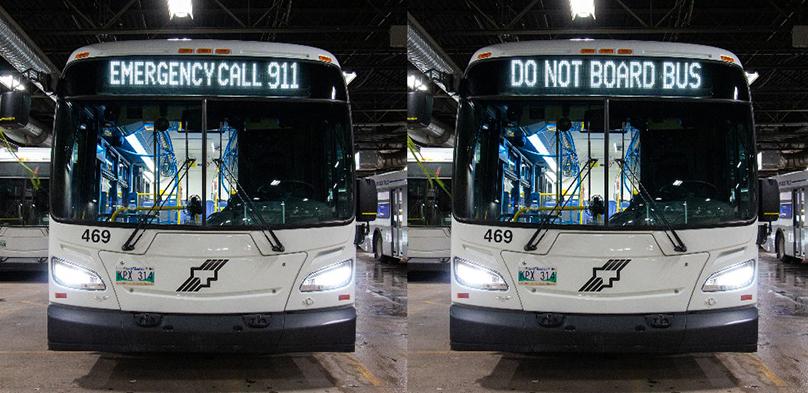
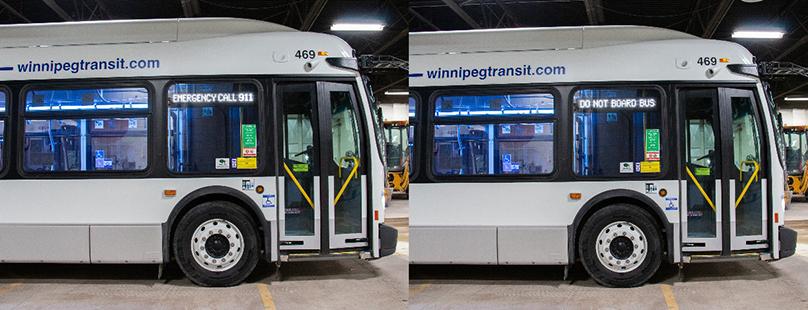
We implemented a new emergency system on buses in 2021.
This system gives Operators the ability to alert the Control Centre and members of the public outside the bus that emergency responders are needed. When enabled, the exterior bus signs read:
- Emergency Call 911
- Do Not Board Bus
We developed this system in consultation with Transit Advisory Committee.
In 2008, we added audio and video equipment to buses. This initiative helped boost safety, spot and prevent crime, and assist with investigations.
We expanded the system to cover the left front interior and exterior in 2017. This led to the increased identification of assailants.
In 2018, we introduced Wi-Fi technology with the fleet-wide installation of LTE modems.
Live camera feeds
We installed live camera feeds on 50 buses in 2021. The streams were accessible to our Control Centre, allowing Supervisors to access the video in the event of an emergency. This pilot was successful and made permanent in May 2024.
Every bus in our fleet is now equipped with a live camera feed. Control Centre Supervisors can immediately tap into the feed on any bus when needed. This allows them to assess situations and dispatch the appropriate emergency services.
Our Control Centre has Supervisors on duty 24/7.
We are always looking to improve the safety of our Inspectors.
In 2019, we provided protective body armour vests to all Inspectors. We also created training focused on de-escalation, including how to spot and assist people using meth.
We also added stations in important places across the city to help Operators and passengers when problems arise.
The Transit Advisory Committee provides input and guidance on all safety-related initiatives. The committee, which we established in 2017, consists of 10 representatives from:
- Transit leadership
- City Council
- The Amalgamated Transit Union (ATU)
- The Winnipeg Committee for Safety
- The Winnipeg Association of Public Service Officers (WAPSO)
- The City of Winnipeg’s Indigenous Relations Division
- The Winnipeg Police Service (WPS)
- Transit Operators
We created a Code of Conduct to provide residents with information about the expect behaviour when using our service. The Code of Conduct states:
- Threats or assaults will not be tolerated
- Riders must pay applicable fare and comply with all fare terms and conditions
- Riders cannot cross the safety line near the front of the vehicle while the vehicle is in motion
- No smoking, littering, spitting, vandalism, or graffiti
- No consumption of alcohol, illegal drugs or inhalation of solvents
- Do not disturb, annoy or interfere with any other person, includes loud, foul, insulting, abusive or inappropriate language
- Do not place feet on bus seat, spill food or beverages or create any unsanitary condition
- No soliciting, selling or distribution of merchandise or printed materials
- Do not impede the movement of passengers or employees
- Any item which may cause an obstruction or unsafe condition is not permitted
- No unlawful carrying of firearms or restricted weapons, explosive, flammable, or toxic material
- Do not extend any body part or object through bus window or door
- Service animals are allowed and all other animals must be in a closed carrier