Profitez pleinement de votre déplacement en transports en commun grâce à ces conseils.
- Utilisez notre planificateur de déplacements Navigo pour préparer votre trajet : il vous proposera cinq itinéraires pour vous rendre à destination
- Si certains trajets vous semblent plus compliqués ou plus longs que prévu, quelques petits changements à votre recherche pourraient faire une grande différence.
- Vous pourriez trouver un trajet plus direct ou plus rapide en décidant :
- de marcher un peu jusqu’à un autre point de départ;
- d’élargir votre plage horaire;
- de réserver un trajet sur demande.
- Vous pourriez trouver un trajet plus direct ou plus rapide en décidant :
- Préparez votre titre de transport avant d’embarquer
- N’oubliez pas votre carte d’identité avec photo si vous bénéficiez d’un tarif réduit
- Si vous payez en espèces :
- Payez le prix exact en pièces uniquement – nos chauffeurs n’ont pas de monnaie.
- Si vous avez besoin d’une correspondance :
- Demandez-la dès que vous montez à bord.
- Si vous payez avec une carte peggo :
- Veuillez la maintenir contre le lecteur jusqu’à ce qu’il émette un bip.
- Si vous montez à bord à l’aide d’une correspondance :
- Tenez-la au-dessus du lecteur de code QR de la boîte de perception jusqu’à ce qu’il émette un bip.
- Faites toujours attention en entrant et en sortant de l’autobus
- Après l’embarquement, allez à l’arrière de l’autobus pour laisser les autres passagers entrer et sortir
- Tirez sur le cordon jaune pour demander votre arrêt
- Sortez par la porte arrière, si possible, en suivant les instructions ci-dessous
- Veuillez sortir par les portes arrière si possiblee
- Attendez que le voyant vert au-dessus des portes arrière s’allume avant d’essayer d’ouvrir les portes
- Les portes arrière s’ouvrent de trois manières différentes, selon le modèle d’autobus
- Bande tactile (bande jaune étroite et en relief) : Appuyez sur la bande tactile et maintenez-la enfoncée jusqu’à ce que la porte s’ouvre
- Capteur (bande jaune large et plate) : Touchez la bande, qui active un capteur de mouvement au-dessus de la porte
- Barre de poussée : Saisissez et tenez la barre jusqu’à ce que la porte s’ouvre
- Les portes resteront ouvertes pendant 3 à 4 secondes
- Par courtoisie pour les passagers suivants, veuillez garder votre main sur la bande tactile ou la barre de poussée pour que les portes restent ouvertes pour eux
Nous avons désigné des zones de sièges réservés et faciles d’accès afin de permettre aux personnes handicapées et à celles ayant des besoins de déplacement supplémentaires de voyager en toute sécurité.
Sièges réservés
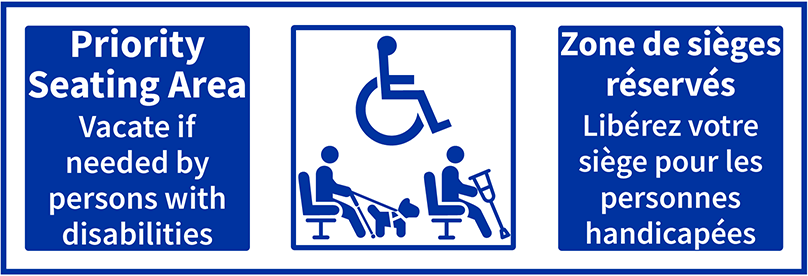
- Signalés par un autocollant bleu
- Situés à l’avant de l’autobus
- Prévus pour les personnes ayant un handicap visible ou invisible
- Comportent des caractéristiques permettant d’accueillir les passagers en fauteuil roulant et en scooter, notamment des sièges qui se rabattent et des stations d’arrimage
- Tout le monde peut s’asseoir à ces places, mais on vous invitera à céder votre place si une personne ayant besoin d’un siège réservé embarque dans l’autobus
- Le chauffeur diffusera un message automatisé transmettant cette demande et, si nécessaire, pourra également rappeler directement aux autres passagers de libérer la zone
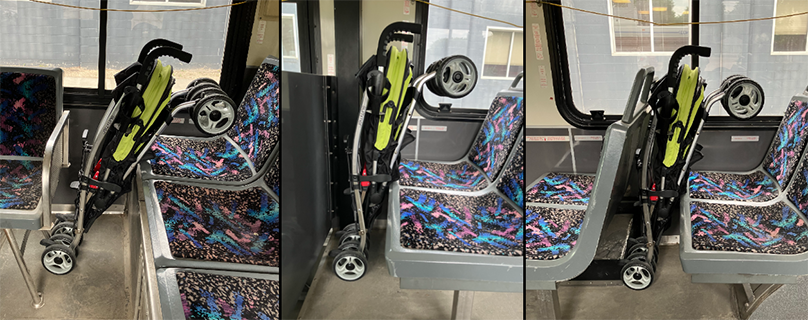
- Cela concerne notamment les passagers avec une poussette, qui peuvent être invités à la plier et à la ranger
Sièges faciles d’accès
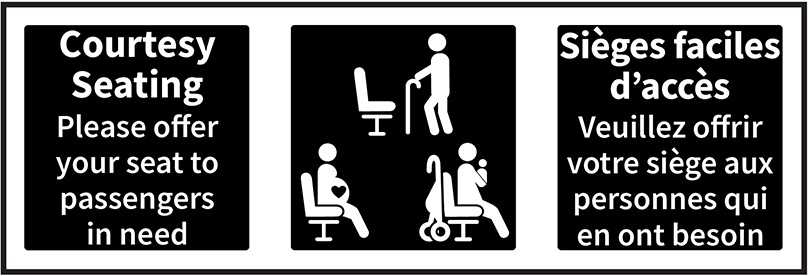
- Signalés par un autocollant noir
- Situés à l’avant de l’autobus, derrière la zone des sièges réservés
- Prévus pour les personnes pour qui il est préférable de s’asseoir près de la porte, notamment les femmes enceintes les personnes âgées, et celles qui voyagent avec de jeunes enfants
- Les sieges faciles d’accès sont disponibles selon le principe du premier arrivé, premier servi.
- Ce qui est de la musique à vos oreilles peut être du bruit pour les personnes qui vous entourent – mettez des écouteurs
- Il est interdit de fumer et d’utiliser des cigarettes électroniques ou vapoteuses dans tous les véhicules de Winnipeg Transit ainsi que dans les abribus
- Les animaux d’assistance peuvent accompagner leur propriétaire dans l’autobus
- Ils doivent rester sur le sol près de leur propriétaire, ou sur ses genoux
- Les animaux domestiques dans de petits dispositifs de transport à main sont autorisés, à condition que vous puissiez les ranger en toute sécurité à bord
- Les sièges réservés sont à l’intention des passagers ayant un handicap
- Les passagers munis d’une poussette peuvent utiliser cet espace jusqu’à ce qu’une personne ayant un handicap en ait besoin
- Soyez prêt à plier et à ranger votre poussette et à vous déplacer vers un autre endroit dans l’autobus en cas de besoin
- Assurez-vous que les enfants en poussette sont attachés à l’aide du système de retenue de la poussette