
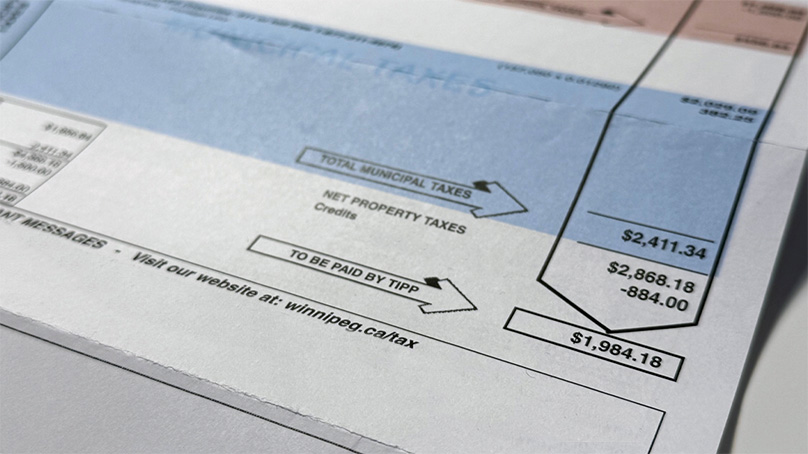
Keep an eye on your mailbox. Your 2026 property tax bill is on the way. We sent them out to approximately 240,500 property owners in Winnipeg earlier this week.
We know tax bills can be overwhelming at first glance. So, let’s break down what you’re seeing and what it means. Follow along using this example on our website, or your own tax bill.
How your taxes are calculated
We looked at a few different things to calculate how much you owe in 2026.
First, check the assessment information at the top of your tax bill. This section shows your assessed value and your portioned assessment. Your portioned assessment is the part of your property’s value that is used to calculate your municipal taxes and education taxes.
For residential properties, the portioned assessment is set at 45 percent of the assessed value of the property. In other words, less than half the assessed value of your residential property is used to calculate what you owe.
To calculate the municipal tax amount, the City multiplies the portioned assessment by the municipal mill rate. City Council sets the municipal mill rate through the budget process. You can see this calculation in the blue municipal tax box on your bill.
Your school taxes are determined using the same equation, but using your school division’s mill rate instead of ours. That’s the red portion of your tax bill. The school division mill rate is determined by your school division.
You’ll also notice a frontage levy on your tax bill. That’s separate from your taxes. It’s based on the length of your property and takes into consideration water and sewer main rates. These are also set by City Council through the budget process.
The frontage levy is used to upgrade, repair, replace, and maintain our streets and sidewalks.
We collect school taxes but don’t set or use them
We’re required by the Province of Manitoba to bill and collect school taxes. The money is then given to the province and school divisions.
Overall, municipal taxes account for 46 percent of what we collect. The other 54 percent goes to education taxes.
While school taxes are on your property tax bill, we do not decide or keep this amount. We have no say over how each of Winnipeg’s eight school divisions set their rates or how that spend money is spent.
Check your credits
Eligible homeowners may receive the Province’s Manitoba Homeowners Affordability Tax Credit. It increased from $1,500 in 2025 to $1,600 in 2026. The Province provides this to offset school taxes for homeowners.
You can only claim this amount for your principal residence and only if it’s assessed as a single residential dwelling. You can’t receive it for more than one home in Manitoba.
If you are eligible but do not see the credit on your property tax bill, you will have to claim the credit on your 2026 personal income tax return filed next year. Reach out to 311 or check out our website for more information.
Understanding changes to your tax bill
Many factors go into your property taxes. This year’s bill is likely different than what you paid last year.
To give you an approximate idea of how much it changed, we’ve created an easy-to-use calculator to help.
You need to input your address, status code, class, assessed value, and if you received the Homeowners Affordability Tax Credit. That information can be found at the top of your property tax bill.
How to pay your property taxes
You must pay your 2026 property taxes by June 30. We offer several different ways to pay, including through your bank or credit union, by mail, or an online third-party credit card service.
You can also stop by our 311 counters at 510 Main Street or at 170 Goulet Street if you’d rather pay in person by cash, debit, or cheque. Just remember to bring ID with your name and address, and your tax bill.
If you are currently enrolled in the Tax Instalment Payment Plan (TIPP), you don’t have to meet the June 30 deadline. Just make sure to keep making your monthly payments and your account is fully paid by December 31. Check the important messages section on your tax bill for how much your TIPP payment changes on July 1.
New applications to TIPP must be received by June 15 to avoid late charges.
What if you don’t pay
If you miss the June 30 deadline, we will apply late penalties on unpaid balances starting July 1. These accrue at a rate of 2.5 percent on the first of each month.
If you pay online, please do so three to five business days in advance. This is how long it takes for your bank or third-party credit card service to process your payment. This will help you avoid late payment penalties.
Consider enrolling in the TIPP program so your taxes are automatically withdrawn monthly through your bank or credit union. You can do this anytime through the year.
Where your money goes
Property taxes help fund the services, programs, and infrastructure you rely on.
We encourage you to explore our budget books to see how this money is invested in our community.
Have questions?
If you have questions about the school portion of your taxes, check your bill. It will include your school division’s name and their phone number for you to contact with your concerns.
Meanwhile, contact 311 if you have questions about the municipal portion of your bill. Our customer service staff will also be happy to help you navigate the payment process or the TIPP program.
Sign up for the Our City Newsletter
We have a lot going on at the City that can affect your daily lives. Stay up-to-date on what is happening by signing up for the Our City Newsletter, emailed each Friday.