
Il faut construire les liens piétonniers menant à des entrées de bâtiment de sorte à ce que tout le monde puisse atteindre sa destination en toute sécurité. Cette règle s’applique à tous les aménagements commerciaux, institutionnels, multifamiliaux et industriels, selon les normes indiquées ci-dessous.
Normes s’appliquant aux liens piétonniers selon le secteur
Secteurs PR1, PR2, PR3; RMF, RMU; C1 à C4; CMU, EI, MMU
Commercial, institutionnel et multifamilial : Norme A
Industriel : Norme A
Secteurs A, RR5, RR2
Commercial, institutionnel et multifamilial : Norme B
Industriel : Norme B
Secteurs M1, M2, M3
Commercial, institutionnel et multifamilial : Norme A
Industriel : Norme B
Exigences de zonage
Le Zoning By-law (règlement municipal sur le zonage) exige que vous prévoyiez une voie piétonnière claire et accessible de l’entrée principale d’au moins un bâtiment principal au trottoir public et à l’arrêt d’autobus le plus proche. Ces pistes doivent aussi relier les entrées de tous les bâtiments principaux et les entrées extérieures de toutes les unités de ces bâtiments.
Lorsque vous demandez l’approbation d’un aménagement, vous devez soumettre des dessins détaillés montrant les liens piétonniers. Ceux-ci nous permettront de confirmer que vous avez satisfait à toutes les exigences.
Exigences de construction
Largeur libre minimum
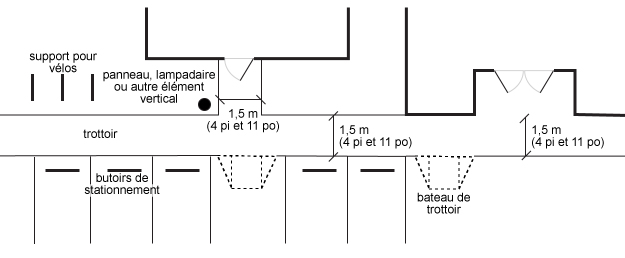
Les liens piétonniers doivent être d’une largeur minimum de 1,5 m (4 pi et 11 po). Assurez-vous que la piste soit dégagée pour que les gens puissent se déplacer en sécurité. N’y prévoyez pas des objets comme des panneaux, des lampadaires ou des supports pour vélos (y compris les vélos verrouillés), ou tout autre objet franchissant les limites de la voie piétonnière. Cela inclut également l’espace pour les portes qui pivotent vers l’extérieur.
S’il y a des places de stationnement à côté de la voie piétonnière, il faudra peut-être des butoirs de stationnement pour empêcher les voitures de bloquer la piste.
Les voies piétonnières aménagées dans des terrains de stationnement doivent être conçues de façon à ce que les gens n’aient pas à traverser de nombreuses voies de circulation ou à marcher derrière des voitures stationnées.
S’il vous faut des bateaux de trottoir reliés à la voie piétonnière, assurez-vous qu’ils n’empiètent pas sur celle-ci.
Matériaux
La construction des liens piétonniers doit inclure une couche de base stable, ferme, antidérapante et anti-reflet. Les matériaux acceptables incluent le béton, l’asphalte et le pavé. Le béton et l’asphalte sont idéaux parce qu’ils fournissent une surface lisse pour les personnes qui utilisent des fauteuils roulants ou d’autres aides à la mobilité.
Pavés
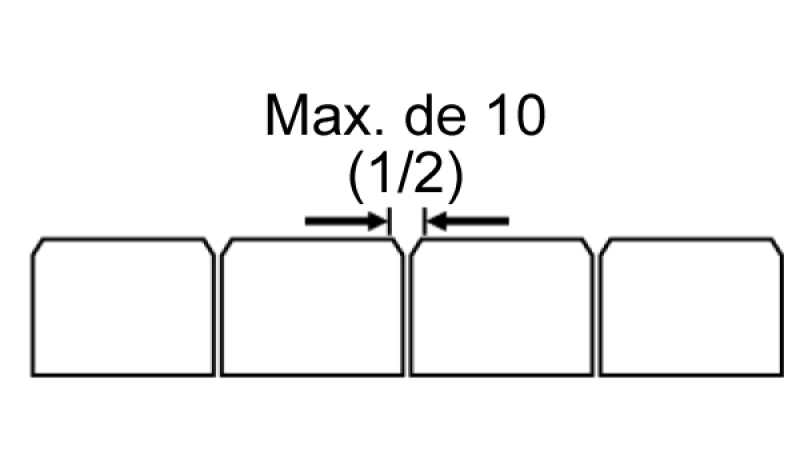
Image 2 : Écartement des joints des pavés
Si vous utilisez des pavés, assurez-vous que les espaces entre eux ne dépassent pas 5 mm. Si les limites sont biseautées, l’espace ne doit pas dépasser 10 mm.
Grilles
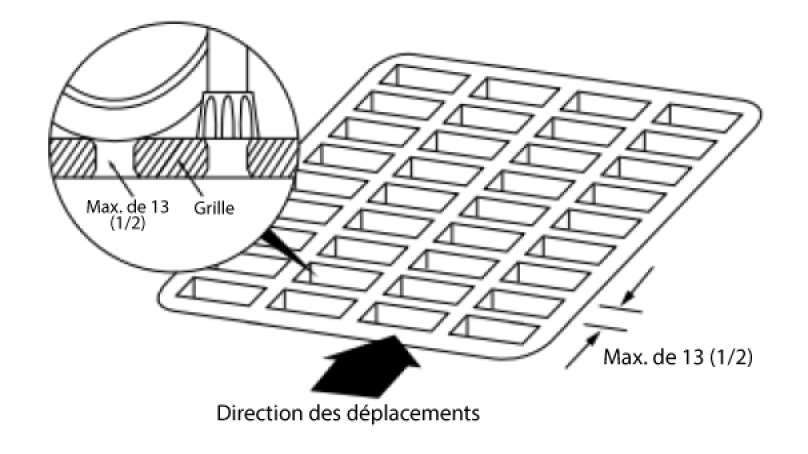
Image 3 : Grilles
Si des grilles ou des bassins de drainage sont situés dans la piste, toute ouverture doit être de moins de 13 mm. Les roues de fauteuil roulant ou les cannes peuvent se prendre dans les ouvertures de plus de 13 mm (1/2 po).
Types de limites :
Norme A
Les limites du lien piétonnier doivent être définies par rapport à la voie de déplacement principale à l’aide de couleurs et de textures offrant un contraste important. Exemples de techniques :
- Ajout d’une bande de pavés d’une couleur contrastante
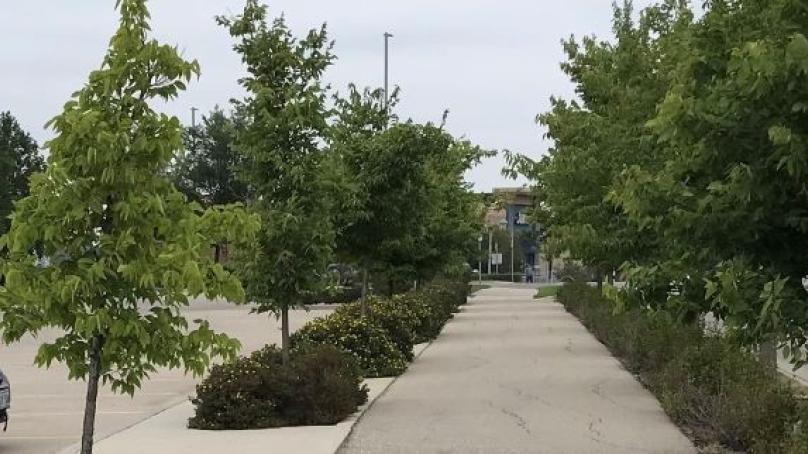
- Incorporation d’une plate-bande ou de gazon
- Pose d’une peinture routière au méthacrylate de méthyle ayant une texture rugueuse
Norme B
Cette norme est identique à la norme A, sauf que les limites doivent différer de la piste principale grâce à un contraste de couleur important seulement, et non grâce à une texture différente. Exemples de techniques :
- Limite peinte
- Béton coloré

Contraste de couleur
Image 4 : Exemple d’un contraste de couleur et de texture à 70 %
Texture différente
Image 5 : Exemple de plate-bandes en bordure
Changements d’élévation
Les surfaces de sol le long des liens piétonniers doivent être exemptes d’élévations verticales créant des obstacles pour les personnes qui se servent d’une aide à la mobilité ou d’une poussette, ou entraînant des risques de trébuchement.
Seule une élévation verticale mineure est permise dans les liens piétonniers accessibles, selon les renseignements qui suivent :
Lorsqu’il y a des surfaces inclinées, l’inclinaison le long des voies piétonnières et celle des bateaux de trottoir doivent être d’un rapport de 1 à 20 (5 %) ou moins. Toute inclinaison supérieure est considérée comme une rampe d’accès sans obstacle et doit être conçue selon le Code du bâtiment du Manitoba.
La pente transversale des surfaces de marche ne doit pas dépasser un rapport de 1 à 50 (2 %).
Bateaux de trottoir
Il peut être nécessaire d’aménager des bateaux de trottoir pour permettre d’accéder à une zone piétonnière élevée adjacente à un terrain de stationnement. Lorsqu’il est nécessaire d’aménager deux bateaux de trottoir pour créer un passage pour piétons traversant une voie de circulation automobile, les bateaux de trottoir doivent inclure un panneau d’avertissement détectable. Pour des conseils par rapport aux dimensions et à la disposition, consultez le devis descriptif SD-229 de la Ville.
Facultatif : Si des trottoirs surélevés sont fournis pour traverser les voies de circulation automobile, ils doivent être conçus de sorte à comprendre des bateaux de trottoir avec des panneaux détectables, et de façon à ce que l’inclinaison des rampes empruntées par les véhicules soit de 5 % au maximum.
Critères de conception recommandés
- Fournissez des panneaux indicateurs lorsqu’il y a un changement de direction le long d’un lien piétonnier et que la destination voulue du lien n’est pas évidente.
- Fournissez un niveau d’éclairage d’au moins 50 lux le long de tout le lien piétonnier.
- Lorsque des objets verticaux sont adjacents à un lien piétonnier, la surface entourant les objets doit être d’une texture et d’une couleur différentes de celles du lien.
Des questions?
Appelez la ligne directe des permis au 204-986-5140 ou consultez notre répertoire.