
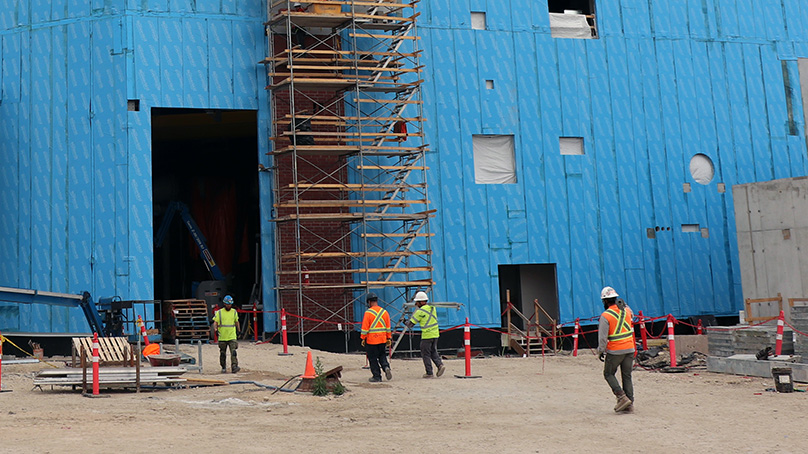
Big projects need big teams.
The upgrade to the North End Wastewater Treatment Plant (NEWPCC) - the largest infrastructure project in Winnipeg’s history - is no exception.
Every day, hundreds of people make their way to the construction site at the west end of Chief Peguis Trail. Decked out in safety gear, they’re helping build what will essentially become the future of wastewater treatment in Winnipeg. This upgrade is essential to support Winnipeg’s growth and to meet our environmental licence.
“We’re reaching our sewage treatment capacity,” said Tim Shanks, the Director of the Water and Waste Department. “If we don’t complete this upgrade, it could severely impact our economic growth.”
Spreading the work out
The upgrades are split into three projects. This helps to make sure there are enough workers for each.
- Project 1: Power Supply and Headworks Facilities is under construction and employs over 200 people. It’s scheduled to be completed this year.
- Project 2: Biosolids Facilities will start construction later this year. Around 400 people are working on just the design stage. That number will only increase once the construction begins.
- Project 3: Nutrient Removal Facilities is in the procurement stage. It’s the biggest of the three projects. It will require the biggest team of designers and construction workers.
“The job market may not be able to support this as a single project because it’s so big, so we had to consider that one of our risks,” said Lana Obach, the Biosolids Project Manager. “Having it delivered in three parts allows us to strategically stagger the labour needs on this mega project.”
Impacting the job market
These projects are tremendously impacting the job market and the local economy.
Our preliminary analysis shows that construction of Projects 2 and 3 will create over 8,700 full-time direct and indirect jobs over the next five or six years.
“These will include a lot of local, high-paying blue collar construction jobs, engineering jobs, and other skilled trades,” said Matt Dryburgh, Deputy Chief Administrative Officer. “Many of these workers call Winnipeg home. They are our family, friends, and neighbours.”
Helping to build careers
Project 2 and 3 will be unique for us as they are using a newer Council-approved social procurement directive. When construction starts on the Biosolids Upgrade later this year, it will be the first NEWPCC project under this directive.
The directive focuses on increasing representation of skilled labour from Indigenous and underrepresented groups. It also encourages projects to foster training and apprenticeship opportunities.
Since this project is expected to take five years, there’s a lot of time for workers to grow their abilities. That means someone who is a general labourer could complete this project as a skilled tradesperson.
We’re also trying to plan for these workers’ future.
“We want to make sure we try to connect anybody who works on this project with other future City projects,” said Obach.
She added that some workers who build the new plant may eventually work at it once it’s open.
Funding the upgrades
With a total budget of over $3 billion, the NEWPCC upgrades are a significant investment in our city’s future. We’ve been able to secure funding for the first two projects from the provincial and federal governments.
Currently, there are no funding agreements for Project 3. That project also has the largest budget at $1.57 billion.
“Without funding from other levels of government, the burden of paying for this project would shift to ratepayers when they can least afford significant rate increases,” said Dryburgh.
While we continue to pursue funding commitments, we are not standing still.
We’ve completed the first stage of the Request for Proposals (RFP) process, and three qualified teams have been shortlisted. Design and construction planning are expected to begin later this year. Full construction is expected to start in 2028.
Completing it is key for sustaining our growth, competitiveness, and environmental stewardship. Once finished, our economists expect it will support GDP growth in the city of over $186 billion from 2033 to 2050. It will also increase our labour force by 91,000 people as we continue to grow towards one million people in Winnipeg.
“This growth impacts not only all of Manitoba, but the entire country,” said Dryburgh. “It allows us to maximize our economic potential. The benefit is just so much larger than today’s price tag.”
Our City, Our Podcast
Engineers Linda McCusker and Lana Obach are on the team leading these upgrades. They joined Our City, Our Podcast to discuss why this massive project is critical for Winnipeg. This episode was released in February 2026.
A view from above
Check out this aerial video. It was taken from above the North End Wastewater Treatment Plant in 2024. It shows the exisiting plant and construction on the upgrades.
Video shared with permission by AECOM. This is a video made with a drone flying over the Winnipeg North End Wastewater Treatment Plant. It starts by showing a wide view of the plant, including many buildings and a large work area. The work area is the site of Project 1: Power Supply & Headworks. This is the first of three upgrade projects at the Plant. The drone then moves in for a closer look and flies over a grassy field with trees. It then flies back to the work area, where there is a large crane and two round chambers. The drone continues to fly, showing the whole plant from a new angle and pointing out round tanks, tall odour control stacks, and rectangular buildings that are part of the existing treatment process. After that, it moves past the plant towards a big empty field. This field will be the future site of Project 2: Biosolids Upgrade and Project 3: Nutrient Removal. Finally, the drone flies high above the field, showing the whole area, including some roads and houses in the distance.