
|
Insect Information
Tree Pests - Gypsy Moth
What are gypsy moths?
What does the gypsy moth look like?
What does gypsy moth damage look like?
How can I control gypsy moths?
Where can I find additional information?

Male and Female

Egg Mass
|
What are gypsy moths?
The gypsy moth, Lymantria dispar, is a moth in the family
Lymantriidae of Eurasian origin. Gypsy moth is a pest of
trees in many regions of the world but is not native to North
America. Two strains of gypsy moth have been recovered in North
America: the European strain, of which the female is flightless;
and the Asian strain, of which the female is capable of flight.
Originally ranging from Europe to Asia, it was introduced to
North America in the late 1860s by a French naturalist
attempting to cross the European gypsy moth with North American
silkworms. His intent was to establish a silk industry on this
continent. Some of the insects escaped and have since
established themselves in Northeastern United States and Eastern
Canada.

Females with Egg Masses
Top of Page
|
|

Male

Female
|
What does the gypsy moth look like?
The gypsy moth overwinters in egg masses attached to the bark of trees. The egg masses, usually about the size of a one dollar coin, are buff to tan in colour
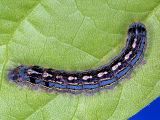
and may contain from 100 to 1,000 eggs. The eggs hatch into caterpillars (larval stage) when tree buds begin to open. This stage, lasting up to seven weeks, is when the insect feeds. The caterpillar is easily recognizable in the latter part of this stage: charcoal grey with a double row of five blue and six red dots on its back. The adult female is approximately 30 mm long, white, with zigzag markings on its wings. The female is incapable of flight and dies about one day after laying its eggs. The male is a brownish colour, much smaller, and survives about one week, mating with several different females.
Top of Page
|

Larva |
What does gypsy moth damage look like?
Gypsy moths are a concern because the larvae feed voraciously on the leaves of both deciduous and coniferous trees. During the larval stage, a gypsy moth caterpillar can eat an average of one square metre of foliage. Leaves play a major role in food production for the tree, converting light into food by photosynthesis. Reducing the number of leaves available to capture sunlight results in a loss in food production. Deciduous trees can sometimes produce a second crop of leaves, but after repeated defoliations trees may become so weakened that they are susceptible to secondary infestations. Evergreens may die after only one defoliation.
Top of Page
|
|
How can I control gypsy moths?
You can help control the Gypsy Moth by
looking for signs of infested material in wood piles. If you
plan on moving firewood, nursery stock or logs inspect them
for signs of the gypsy moth. If you see signs do not move
the infested material.
If you think you have found the gypsy moth
you should:
-
Record the location of the tree,
-
Record the Signs and Symptoms you observed,
-
Collect an adult specimen, keep it in a
container in a freezer (to preserve it), and
-
Contact the
Canadian Food
Inspection Agency or call the 1-800-442-2342.
Physical Control
It is important to be thorough when looking for egg
masses as they may be difficult to locate. Common hiding places
are the underside of branches, tree trunks, fences, firewood,
outdoor furniture, swing sets, boats, trailers and under the
eaves of buildings. When an egg mass is observed it should be
scraped off with a knife and dropped into a bucket filled with
hot water and household bleach or ammonia. Larvae and pupae can
be handpicked and crushed. Some persons are sensitive to the
long hairs of the larvae. As a precaution, gloves should be worn
when handling the insect.
Biological Control
Bacillus thuringiensis
var. kurstaki (Btk) is a selective biological insecticide which controls lepidopterous larvae (caterpillars).
Btk crystals release a toxic protein when dissolved in the alkaline digestive system of the insect. The caterpillar stops feeding soon after, and dies within five days. Other insects, mammals, birds and fish are not affected by
Btk.
Where can I find additional information?
Province of Manitoba Forestry Branch: Gypsy Moth Monitoring Results
Canadian Food Inspection Agency (CFIA): Gypsy Moth as Plant Pest
City of Winnipeg Gypsy Moth Control: Gypsy Moth Control in Winnipeg
Top of Page
|
|